Steel and Story: The Southern Master Engravers Carving History Into Every Firearm
There's a shotgun hanging above a fireplace in a farmhouse outside Tuscaloosa, Alabama, that hasn't been fired in thirty years. It doesn't need to be. The thing is a work of art — scrollwork curling along the receiver like kudzu on a fence post, a whitetail buck etched into the side plate with enough detail that you can almost count the tines. The owner's grandfather commissioned it in 1971. His father inherited it. Someday, it'll pass to a grandchild who hasn't been born yet.
That's exactly the point.
Firearm engraving is one of those crafts that most people have heard of but few truly understand. It sits at a strange and beautiful crossroads — part metallurgy, part fine art, part cultural preservation. And while the rest of the country has largely moved on to laser etching and CNC-cut patterns, a stubborn, talented group of Southern artisans is keeping the hand-engraving tradition burning like a forge fire that refuses to go cold.
More Than Decoration — It's Documentation
Ask any master engraver worth his burins what separates real hand engraving from the machine-produced stuff, and he'll tell you the same thing: soul.
That might sound like marketing talk, but there's genuine truth to it. When a craftsman lowers a hand-held graver to a steel receiver and begins cutting, he's making thousands of individual decisions — depth of cut, angle of approach, pressure, direction. No two strokes are identical. No two finished pieces are the same. A laser can reproduce a pattern with robotic precision, but it can't make a judgment call. It can't feel the metal give just slightly differently at the edge of a curve and compensate in real time.
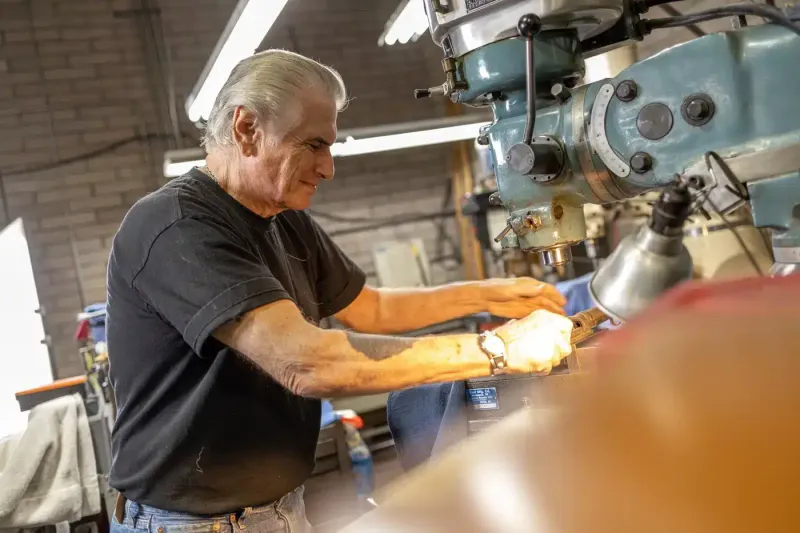
For engravers like Ray Doss, who operates out of a converted barn in rural Tennessee, that distinction matters deeply. "I've been doing this for going on twenty-eight years," he says, running a thumb along a half-finished rifle stock. "And I still pick up a piece of steel and feel like it's trying to tell me something. You listen to it. The machine doesn't listen."
Ray learned the trade the old-fashioned way — sitting beside an older craftsman who barely spoke but showed him everything through demonstration. That apprenticeship model, largely abandoned in most American industries, persists among Southern engravers almost out of necessity. There are no four-year degrees in this. You learn by watching, then doing, then failing, then doing again until your lines are clean and your scrollwork flows like water.
The Vocabulary of the Craft
Engraving styles read almost like a regional dialect. Bulino, the Italian pointillist technique, creates images through thousands of tiny dots. American scroll — arguably the most recognizable style in the Southern tradition — features bold, flowing foliate designs that frame action flats and barrel tangs. English-style engraving tends toward tighter, more formal patterns, often incorporating fine crosshatching. German oak-leaf work is heavier, more architectural.
Many Southern engravers blend these traditions freely, developing hybrid styles that reflect both their training and their roots. It's not unusual to see a Mississippi-made rifle carrying American scroll on the receiver alongside a hunting scene rendered in bulino on the floor plate — a full visual story told in steel.
That storytelling element is central to why clients seek out hand engraving in the first place. A man commissioning a piece for his son's first deer rifle isn't just ordering a service. He's creating an object with a narrative baked into it. The deer etched on the side plate might be modeled after a specific buck from a specific ridge on a specific morning. The family name cut into the grip cap will be there a hundred years from now, legible as the day it was made.
The Tools Haven't Changed Much — And That's the Point
Walk into a serious engraving shop and you'll see a bench that looks like it could belong to a craftsman from 1880 or 2024. Pneumatic handpieces have replaced some traditional push-gravers, and optivisors have gotten better, but the fundamental toolkit — sharp steel burins, a rotating vise called a ball vise, magnification, and light — hasn't changed dramatically in over a century.
That's a feature, not a bug. The tools are simple because the work itself demands simplicity. There's nowhere to hide on a polished steel surface. Every hesitation mark, every slightly wobbly line, every miscalculation is permanent. You can't hit "undo." You develop clean technique or you don't work on fine firearms. It's that unforgiving.
Caroline Thibodaux, a Louisiana-based engraver who trained under a Belgian master before returning home to set up her own shop, describes the process as meditative in the best possible way. "When I'm working, time disappears. I'm not thinking about anything except the next cut. There's a real peace in that. People talk about mindfulness now like it's a new concept, but craftspeople have always known it."
Caroline specializes in wildlife scenes and has developed a following among waterfowl hunters in the Gulf Coast region. Her pintails and mallards, rendered in delicate bulino on shotgun receivers, have earned her a waitlist that stretches well over a year.
Passing It Forward
The biggest challenge facing the Southern engraving community isn't competition from machines or changing tastes. It's succession. The average master engraver has been at this for decades. The pipeline of young talent learning the trade is thinner than anyone in the craft would like.
Some shops have responded by offering formal apprenticeships. Others teach weekend intensives or partner with vocational schools to introduce the basics to students who might not otherwise encounter the trade. The American Engravers Guild and similar organizations have worked to document techniques and create resources that didn't exist a generation ago.
But most practitioners will tell you that the real transmission of knowledge still happens the old way — one person watching another, for a long time, with patience and humility on both sides.
"I've got a young guy working with me now, been here about two years," Ray Doss says. "He's starting to develop a feel for it. You can see it in the way he holds the tool — less tension. That takes time. You can't rush it. And honestly, that's kind of the whole lesson of this trade right there."
An Heirloom Isn't Just an Object
There's something distinctly Southern about the idea that a functional tool can also be a treasure. The South has always understood the dignity of useful things — that a well-made rifle, a well-stitched quilt, a well-built piece of furniture carries meaning beyond its function. It carries the hands that made it and the people who used it.
When a master engraver sits down to embellish a firearm, that's exactly what he or she is creating. Not a showpiece to sit behind glass, necessarily — though many do — but an object that earns its beauty through purpose. A rifle that shoots straight and looks like a painting. A shotgun that breaks birds in the morning and hangs above the mantle with quiet dignity in the evening.
That's the Southern way of making things. Built to last. Built to mean something. Built to be handed down.
And somewhere in a shop between pine woods and red-clay roads, somebody's bent over a vise right now, making one cut at a time, making sure the next generation gets something worth keeping.